Monster Hunter Stories 3: Twisted Reflection on PlayStation 5 Review
As featured in the April Issue of Mage Magazine, Paige reviews Monster Hunter Stories 3, the latest Monster Hunter Stories game from Capcom.
By Paige Chamberlain
I’m continuing my pattern of finally beating a game in a series via the newest entry rather than any other games I’ve put time into. With that said I only played like ¾ of the first game and like none of the second so if some of the stuff I’m praising was in the last one you’re just going to have to cope. If you’d like a version of this review with a lot less structure check out our episode on the game in the podcast.
Monster Hunter Stories is a spin-off of the mainline Monster Hunter series but instead of action-based constant boss fights to make new vests, you instead engage in turn-based battles side by side with your “monsties”. In the third entry of the series you get to play as a member of royalty who is also captain of the rangers, a group of riders that focus on preservation of the natural ecosystem. Unfortunately, getting in the way of that is an impending war as your neighbouring country is demanding they break a covenant that the continent is bound to and explore a forbidden area. In short work you gain an extra party member as a political hostage and not long after that, end up breaking the law yourself. Soon finding out more about the world and why you were forbidden from leaving in the first place.
The combat system in this game is really fun. You have yourself, your monstie, a battle ally, and their monstie for a party of four. Although, you can only control yourself and your monstie if you so choose. This meant I often had to choose my party member based on their patterns of attack, such as not picking the gunlance user Kora who often taunted if I wanted to use counterattacks, or not picking Gaul when fighting regular monsters batches as he’d waste time on a unique skill that’d do mere chip damage to debuff a monster he could’ve killed in one swing.
Outside of the typical turn-based RPG trappings, the main feature in the Stories series is the paper-scissors-rock system of power-technical-speed attacks. Monsties default attacks are whatever their attack type is, although they can learn or be equipped with alternate attack types. Before you initiate your turn, you can see who the enemy is aiming at and if for example it’s at you. You can do one of those three attack types (instead of a neutral move) and you’ll enter a head-to-head with the winner (based the triangle of speed beating power beating technical beating speed) getting to actually use their attack whilst the loser misses their turn and gets hurt. Draws will result in both combatants taking a bit of damage. Most monsters seem to go with an attack type that suits them such as Velocidromes initially starting with speed attacks but whenever they are agitated they’ll switch it up. It can be hard to learn which attack types you need to go for but it can be super handy as you’ll prevent damage from happening, although there seem to be a lot more neutral attacks at least from the enemy so it’s not every single turn.
If you and a monstie on your team both do the same type of attack aimed at the same part of the same monster you’ll do a double attack for extra damage that also contributes to the kinship gauge. The kinship gauge fills up as you successfully attack and once at level 1 you can hop onto your monster to either immediately use your unique kinship attack (which can be doubled up if your battle ally is also mounted) or bring it up to level 3 by successfully attacking and not taking too much damage so that your special attack will be all the greater.
Your own character can equip three weapons at once and switch between them at will. Slashing, blunt, or piercing damage is aimed at different body parts to break them apart, which might be necessary to temporarily stun them or to weaken skills. The handful of weapons also come with their own unique traits such as gunlances having shells that need to be reloaded or hunting horns providing buffs as well as damage. Monsters often rotate through phases and some will get a lot stronger but can be temporarily beaten out of that phase if you break the new parts that show as attackable. Another system is the wyvernsoul gauge which are these red gems below the enemies health bar that get beaten down more easily with part breaking. Once depleted, the monster will get toppled and you can do what is essentially an all out attack. Unfortunately, if there are multiple monsters you’re fighting against even if you topple them all in the same turn you don’t get to do the special beat up attack. Different monsters have unique gimmicks, whether it’s particular bosses, repelling the invasive monsters or having to guess which dirt pile the Nibelsnarf is hiding in. Dying has very little consequences in this game unless you are making your way through one of the more linear areas and have to push back through to get to where you were until you find the next catavand stand (save and fast travel points), or carrying an egg as you’ll be sent out of the den sans-egg and can’t return. I do sort of miss not having any set-piece fights like with cannonballs or dragonators but I suppose that would veer too much into the mainline’s action territory. The game has plenty of hype moments but maybe not so much aura.
Another important part of team building is the rite of channeling which lets you transfer genes from one monstie’s 3×3 grid to the other’s. These can create bingos if they share the same trait or element to increase the damage or give other benefits. Later on in the game, this can become essential or at least often easier than recruiting an entirely new monster (which I only had to do a couple of times).
Just like the mainline series, your weapons and equipment can be swapped around, upgraded, or given extra benefits which becomes a lot more important against bosses as you won’t want to be weak to your attacks. Thankfully, creating the perfect outfit is a lot easier in this game as the fights are much quicker than the mainline games. I do have a bit of a hang-up over what armor made it to the game as I fought the Odogaron and was looking forward to wearing awesome gear until I realised it was the uglier alpha ones, for shame.
Outside of direct combat, you have expansive areas with verticality making the traversal traits of climbing and flying (really just gliding) essential with some other skills such as digging or swimming only sometimes needed. I stuck with my rank C Tobi-Kadachi (nicknamed Tobi-Wan Kenobi) through the whole game since he could both climb and glide making getting around much easier without having to swap another monstie in. Littered around these maps are several enemies (some of which you might need to avoid due the difference in strength), side quests and dens. Said enemies may occasionally get the jump on you from behind (as you may do to them) or by simply emerging from the ground before you can get out of the way. If you want any real dungeon type environments those are all but exclusive to the side stories with Kora. There are regular style sidequests, and poogies to find, but all your party members have a few side stories that continue throughout the main plot, getting you both closer to these characters but also giving benefits such as making your allies stronger or getting a new recipe to cook for timed buffs. It’s here you learn that Monster Hunter Stories 3 is a true blue JRPG down to the details of including a janky minigame if you want to befriend Thea with the poogie races. I didn’t actually have any trouble with them until the last one whereupon I learned the controls are truly different from the main areas as you can’t turn around and had to reset the race a couple of times.
You carry with you a part of six monsties that can be swapped out at any time both in and out of battle, except for the series-tradition-mandatory Rathatlos named Ratha who can never be removed from the party.
The dens are how you can get more monsties as you approach a nest and select from a small pool of eggs and painstakingly carry it old-school style whilst your companions stare at you and offer no assistance. The dens are often empty but may have monsters, possibly awake or sleeping. Many times a monster will return part way through your egg search and once spotted you won’t be allowed to search for more. Sometimes you can squeeze out without having to fight, but if you do get caught you can keep the egg so long as you win. From there you take the egg back to the stables to hatch before lamenting it didn’t have the skill you wanted to transfer over to a monstie you actually plan on keeping in your team. There are a decent number of hatchable monsters including some from Rise and Wilds since this is the first Stories game since their release which is always a nice touch. It definitely includes plenty of my favourites.
Unique to this game is the habitat restoration feature. First, you’ll have to beat a feral monster who is partially crystalised and has a nasty counterattack to establish a camping base and that will let you re-release hatched monsters back into the nearby area in order to increase their population. This will not only actually make particular monsters show up in the world but give you the benefit of higher quality eggs which can not only lead to better genetics but mutations. These mutations are not only natural variants that occur in the mainline games like a Blue Yian-Kit-Ku or a Dreadqueen Rathian but also general colour changes such as a black “Purple” Ludroth and alternate element types. There are invasive monsters which are super strong, you’ll have to change the time to night and pick up tracks to learn what the requirements to repel them are and try not to get caught beforehand as they are way too tough to beat when you first encounter them. Thankfully, you only have to do this twice, but there are plenty more you can optionally tackle, some of which gave me trouble such as the Black Khezu or the monster that needed a mud attack but only Almudron counted, not Barroth. Once they retreat you can sneak into their den and get an endangered egg so that you can reintroduce a species into the wild and immediately regret doing so as was the case with Zinogre.
If you want even more of a challenge, fighting at night will spawn an extra tough Elder Dragon, most of which are basically post-game level unless you really know what you’re doing, and those too can be released back into the wild which feels perhaps a bit more unrealistic but hey, dogs can hatch from eggs in this game so who cares about upsetting the balance of the ecosystem with life sucking monsters.
The story isn’t super special and those who watched the trailers might be disappointed at how little the brewing war part of the story seems to matter or create any setpieces. The story focuses more on a typical adventure with a light touch on environmentalism and hey that’s the second monster collecting game that came out in March that focused on restoring habitats. I got to know the party members fairly well and liked them except for Kora who would say “useless’ whenever I lost a fight so she can go to h-take me on another dungeon run. There is a returning character from 2 who vaguely speaks of past events to compare you and Rudy to the previous characters, but the story itself doesn’t require playthroughs of other games. Although if you do, you get some costume save data bonuses. The gameplay is the real star of the show but the story is by no means bad; it just didn’t quite go where I’d hoped it might have.
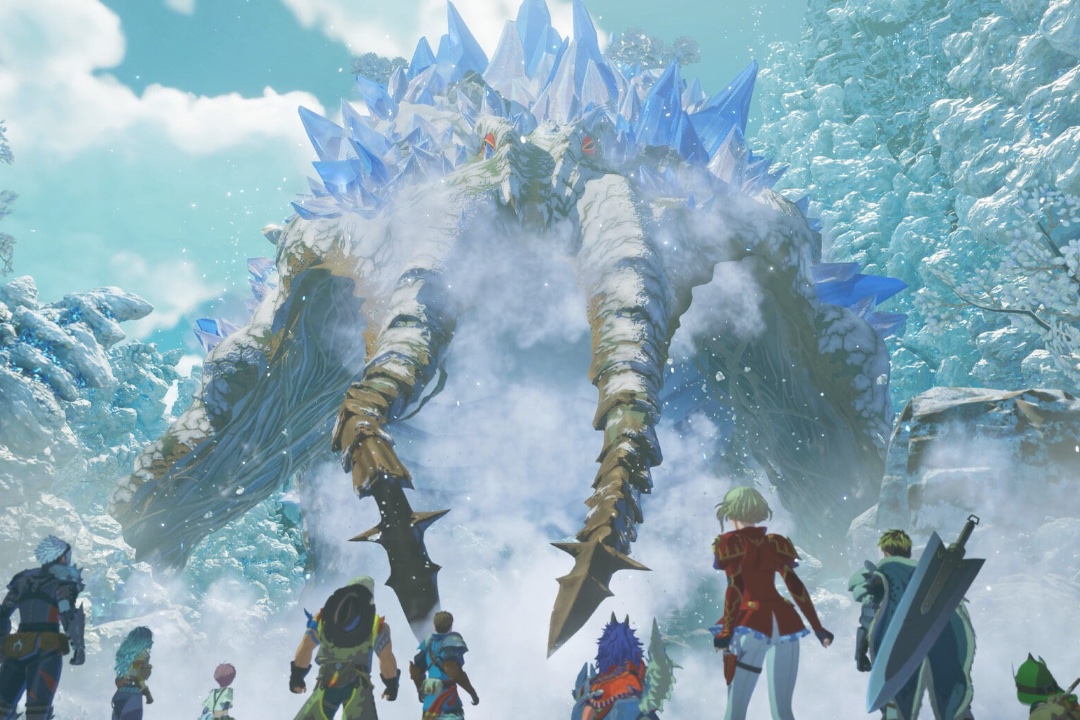
Once again I didn’t pay too much attention to the music although it did get rather dramatic for basic encounters in the final area. They do know when to use their important leitmotifs though. Graphically speaking this game is utterly gorgeous and is quite the glow-up for the series now completely going for more realistic proportions, this does come with the sacrifice of monsters now not looking quite as cute as they did in previous entries. The human (and wyverian) characters all look lovely and are well animated (as of course are the monsters with their different attacks). There is unfortunately plenty of pop-in in these areas but otherwise it runs quite smoothly on a base PS5. Actually I’m underselling the visuals, the areas are vast with soft colouring and utterly stunning assets such as a petrified Lao-Shan Lung that you can climb and the smaller towns are filled with insane levels of detail.
I did lose my mind at one of the places being called Sheparden. Furthermore, I would really like a photo mode to be added.
The voice acting is present for most of the game although you might miss some party chats that pop-up in the left of the screen since those aren’t voiced. I do have to admit that I probably would not have stuck with the Monster Hunter language if they included it as it does add a lot to the cutscenes and even your purrhaps less annoying felyne companion Rudy’s voice isn’t too unbearable.
It took me roughly forty hours to beat as I mostly followed the story path and only did a few optional things. Although the game appears to not suspend or let you pause cut-scenes which is terribly inconvenient and sloppy for such a prolific company. The only major complaints I have with this game is that the gliding does not feel very good, aaaand the toppling thing. I do also have many nitpicks such as the choice of armor pieces but it doesn’t ruin the entire game for me. It was super fun to play through Monster Hunter Stories 3 and I wish I could give the game a hug. The only time I didn’t have much fun was towards the end trying to get a particular gene to spawn so that I could get past the final boss. The many systems of the game feel rewarding and the combat is super enjoyable once you get a handle on it and there are plenty of ways to extend your run time if you so choose.